Corrosion Resistance, Maintenance, Service Life & Core Knowledge
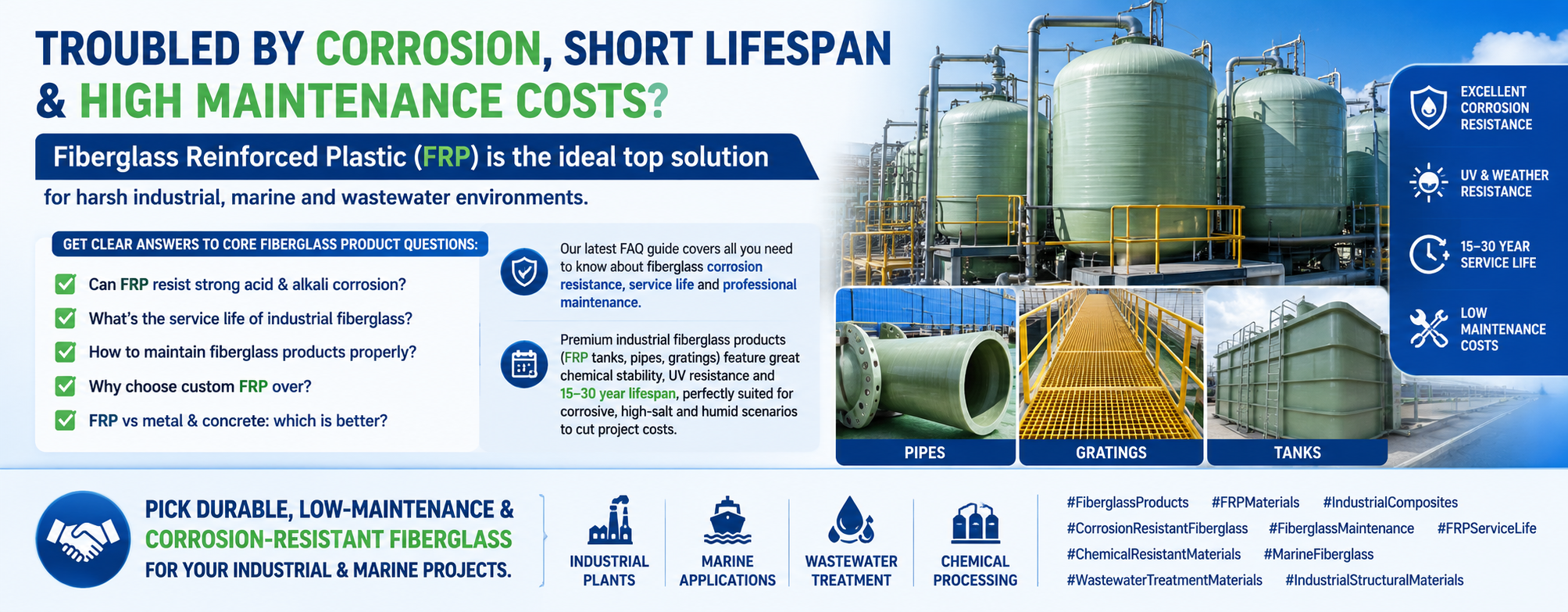
Fiberglass reinforced plastic (FRP), commonly known as fiberglass, has emerged as one of the most versatile and widely used composite materials in modern industrial, commercial, and civil engineering fields. Thanks to its unique combination of lightweight structure, exceptional durability, superior chemical stability, and cost-effectiveness, fiberglass products have gradually replaced traditional metal, wood, and concrete materials in numerous scenarios including chemical engineering, sewage treatment, marine engineering, construction, and municipal facilities. However, despite its widespread application, most buyers, engineers, and maintenance personnel still have various doubts about fiberglass product performance. The most frequently asked questions focus on fiberglass corrosion resistance, service life, daily maintenance methods, and application limitations. This comprehensive FAQ blog systematically sorts out high-frequency user questions about fiberglass products, provides professional, detailed, and practical answers based on the inherent material characteristics of FRP, and solves common confusion in selection, use, and maintenance for enterprise purchasers and engineering practitioners.
1. Can Fiberglass Products Resist Strong Acids and Strong Alkalis? Complete Corrosion Resistance Analysis
Corrosion resistance is the core advantage of fiberglass products and the key reason why FRP materials are favored in harsh chemical environments. Different from metal materials that are prone to oxidation, rust, and chemical erosion, and concrete materials that are easy to be corroded and weathered, high-quality fiberglass products have excellent inert chemical properties, but their acid and alkali resistance is not absolute, which is closely related to resin type, manufacturing process, and medium concentration.
First of all, for strong acid environments, standard epoxy resin fiberglass and vinyl ester resin fiberglass show outstanding resistance. Fiberglass products made of vinyl ester resin can stably resist high-concentration hydrochloric acid, sulfuric acid, nitric acid, and various organic acids for a long time, and will not produce chemical reactions, peeling, or structural aging. Epoxy-based FRP is suitable for medium and low-concentration acid environments, with stable performance in daily chemical sewage and acidic industrial wastewater. It is worth noting that ordinary unsaturated polyester fiberglass has weak resistance to high-concentration strong acid and is only applicable to weak acid and neutral conventional environments.
In terms of strong alkali resistance, professional alkali-resistant fiberglass products adopt modified resin formulas and special fiber weaving processes, which can effectively resist the erosion of sodium hydroxide, potassium hydroxide, and other strong alkali solutions. High-performance alkali-resistant FRP can work stably in high-concentration alkali liquid environments for a long time, avoiding the brittle failure and structural damage that easily occur in metal materials. For low-concentration alkali water, alkaline sewage, and soil alkali environments, all qualified industrial-grade fiberglass products can maintain stable performance without corrosion and deterioration.
In addition to acid and alkali resistance, fiberglass products also have good resistance to salt water, seawater, oil stains, and most chemical solvents. This is why FRP corrosion-resistant equipment is widely used in sewage treatment plants, chemical workshops, marine platforms, and coastal engineering projects. To sum up, professional customized fiberglass products can fully adapt to most strong acid and strong alkali working conditions, and users only need to select the matching resin formula according to the actual use medium to achieve optimal corrosion resistance.
2. What is the Service Life of Fiberglass Products? Key Factors Affecting Lifespan
Service life is a key indicator that users pay most attention to when purchasing fiberglass structural products. Different from consumable materials, fiberglass products are mostly used for fixed facilities and structural equipment, and their service life directly determines the project cost and long-term use effect. In standard use environments and with standardized maintenance, the service life of qualified industrial-grade fiberglass products can reach 15-30 years, and high-grade customized FRP products for special harsh environments can even serve for more than 30 years.
There are three core factors affecting the service life of fiberglass products. The first is material formula and production process. High-quality fiberglass products use high-purity glass fiber yarn and high-grade corrosion-resistant resin, with compact integral molding, no gaps, and uniform resin wrapping. Such products have strong anti-aging and anti-erosion ability and a long service life. Inferior products use recycled materials and low-grade resin, with loose internal structure, which is prone to water absorption, delamination, and aging, and the service life is often less than 5 years.
The second factor is the use environment. Fiberglass products used in indoor, dry, and neutral conventional environments have the longest service life, with basically no aging damage in 20 years. Products used in coastal high-salt, high-humidity, outdoor ultraviolet exposure environments, and long-term strong acid and alkali erosion environments will have a slightly shortened service life. However, after adding anti-ultraviolet coating and adopting corrosion-resistant customized formulas, the service life can still be guaranteed to more than 15 years.
The third factor is daily maintenance status. Fiberglass products with regular standardized maintenance can effectively delay aging, avoid local damage expansion, and maximize the service life. On the contrary, long-term neglect of maintenance, accumulation of dirt and corrosive attachments, and artificial collision damage will greatly reduce the service cycle of FRP products. Compared with metal products (easy to rust and deform) and wooden products (easy to rot and crack), fiberglass products have far longer overall service life and lower replacement cost, with excellent long-term cost performance.
3. How to Maintain Fiberglass Products? Professional Daily Maintenance & Care Guide
Although fiberglass products are known for low maintenance and high durability, scientific and standardized daily maintenance can effectively extend their service life, maintain surface finish and structural stability, and avoid unnecessary damage and failure. The maintenance of fiberglass products is simple and low-cost, and the core maintenance rules are summarized as follows, suitable for all FRP facilities such as fiberglass tanks, fiberglass pipes, fiberglass grilles, fiberglass guardrails, and marine fiberglass accessories.
3.1 Daily Cleaning: Keep the Surface Clean and Tidy
In daily use, the surface of fiberglass products will accumulate dust, sludge, chemical residues, and other dirt. Long-term accumulation of corrosive residues will slowly erode the surface resin layer and affect the anti-aging performance. For conventional surface dust and floating dirt, wipe with a clean soft cloth or rinse with clean water. For stubborn stains and chemical attachments, use neutral detergent for cleaning, avoid using strong acid, strong alkali, and high-corrosion cleaning agents, so as not to damage the surface protective layer of fiberglass. After cleaning outdoor fiberglass products, ensure the surface is dry to avoid long-term water soaking.
3.2 Regular Inspection: Timely Troubleshoot Hidden Dangers
It is recommended to conduct a comprehensive inspection of fiberglass equipment and facilities every 3-6 months. The inspection focuses on checking whether there are local cracks, peeling, delamination, abrasion, and color fading on the product surface, whether the connecting parts are loose, and whether the sealing parts are aging. For small-area surface abrasion and slight peeling, repair and polish in time to prevent the damage from expanding to the internal fiber structure. For outdoor fiberglass products exposed to ultraviolet rays for a long time, regularly check the integrity of the anti-ultraviolet coating, and repair the coating in time if it falls off.
3.3 Environmental Protection & Load Standard Management
Do not exceed the rated load and pressure of fiberglass products for a long time. Overload use will cause permanent structural deformation and internal fiber damage of FRP products, affecting structural stability. For fiberglass products used in high-corrosion environments, regularly clean the internal corrosive deposits to avoid local concentrated erosion. In winter low-temperature environments, prevent water accumulation and freezing inside fiberglass pipes and containers to avoid structural cracking caused by volume expansion of ice.
3.4 Regular Anti-Aging Maintenance
For outdoor fiberglass facilities that have been used for more than 5 years, it is recommended to apply a special anti-ultraviolet and anti-aging protective coating every 2-3 years. This can effectively resist the aging and fading caused by long-term sunlight irradiation, prevent the resin layer from brittleness, and keep the product's structural performance and appearance intact for a long time.
4. Other Common FAQs About Fiberglass Products
4.1 Are fiberglass products waterproof and moisture-proof?
Qualified integral-molded fiberglass products have excellent waterproof and moisture-proof performance. The compact resin sealing structure has no water seepage gap, and will not absorb water, deform, or mildew in high-humidity and long-term water-soaked environments. It is an ideal waterproof and moisture-proof structural material, widely used in underground pipe networks, water storage tanks, and wet workshop facilities.
4.2 Are fiberglass products easy to deform and damage?
Industrial-grade fiberglass products have high structural strength, good toughness, and strong impact resistance. They are not easy to deform under conventional pressure and impact. Different from brittle ordinary plastic products, FRP products have the dual advantages of fiber toughness and resin stability, with strong wind resistance, pressure resistance, and impact resistance, and can adapt to complex outdoor and industrial working conditions.
4.3 Are fiberglass products environmentally friendly and safe?
High-quality fiberglass products are non-toxic, odorless, and environmentally friendly, meeting national and international industrial environmental protection standards. They will not release harmful substances in the process of use, and have no pollution to water quality, soil, and air. Moreover, fiberglass materials have strong recyclability, low carbon emission in the production process, and are energy-saving and environmentally friendly new composite materials.
Conclusion
As a high-performance composite material, fiberglass products have irreplaceable advantages in corrosion resistance, service life, environmental adaptability, and later maintenance. Professional customized FRP products can stably cope with strong acid, strong alkali, seawater, high humidity, ultraviolet exposure, and other harsh environments, with a service life far exceeding traditional materials. At the same time, fiberglass products have the characteristics of simple maintenance, low cost, and high safety, which can effectively reduce the long-term operation and maintenance cost of engineering projects. By mastering the core performance characteristics and scientific maintenance methods of fiberglass products, users can reasonably select and use FRP products, maximize product value, and ensure the long-term stable operation of equipment and facilities.