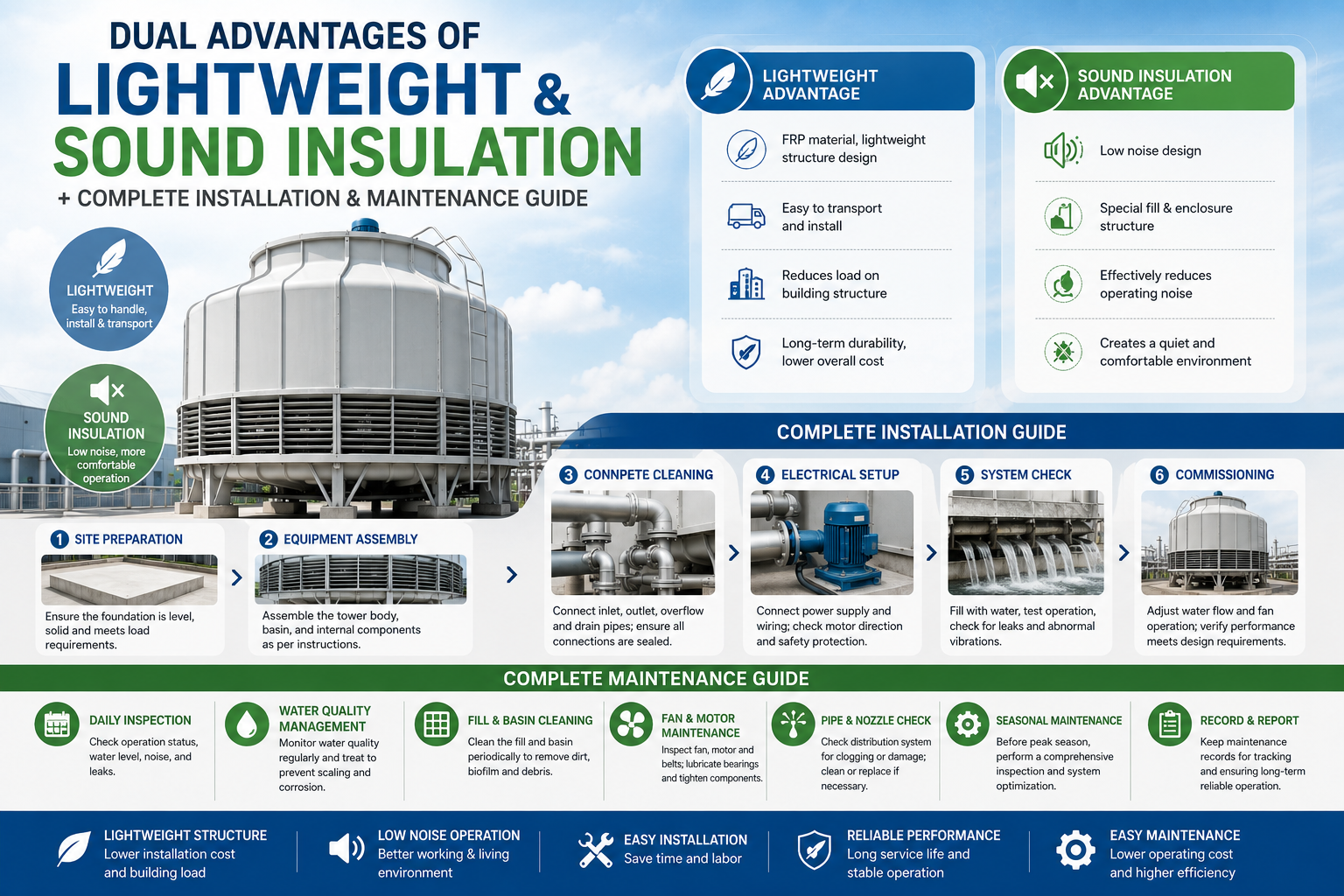
In industrial ventilation, wastewater treatment, chemical plants, and commercial buildings, FRP (Fiberglass Reinforced Plastic) fan housing has emerged as a game-changer, replacing traditional metal housings. It stands out for its lightweight design, excellent sound insulation, corrosion resistance, and low maintenance, making it the top choice for modern fan systems. This blog dives into FRP fan housing’s material traits, how lightweight construction cuts energy use, sound insulation test data,
1. Core Material Traits of FRP Fan Housing
FRP (fiberglass reinforced plastic) is a composite of high-strength fiberglass and corrosion-resistant resin (polyester/epoxy). Its key properties make it ideal for fan housings:
Lightweight & High Strength: 70–80% lighter than steel, 30–50% lighter than aluminum, yet with a strength-to-weight ratio matching steel. Reduces structural load and eases handling.
Superior Sound Insulation & Vibration Damping: FRP’s natural damping absorbs vibration and blocks noise transmission, unlike metal which resonates. Cuts operational noise significantly.
Corrosion & Weather Resistance: Resists acids, alkalis, salts, solvents, and UV rays. No rust, 3–5× longer lifespan than steel in harsh environments (chemical plants, marine, wastewater).
Non-Conductive & Spark-Free: Safe for explosive/humid areas (paint shops, underground parking).
Smooth Inner Surface: Minimizes air turbulence, reduces dust buildup, and maintains airflow efficiency.
2. Lightweight Design: Cut Fan Energy Consumption
The lightweight FRP fan housing directly boosts energy efficiency—critical for cost savings and sustainability.
Lower Starting Torque: FRP’s light weight reduces the motor’s starting load. Fans need smaller HP motors, cutting power consumption by 5–10% vs. metal fans.
Reduced Structural Load: Lighter housing eases stress on mounting structures (walls, roofs, supports). Cuts installation material costs and long-term structural maintenance.
Easy Handling & Installation: 2–3 workers can move and install FRP fan housings without heavy equipment, saving labor time and costs.
Extended Component Lifespan: Lighter weight reduces wear on bearings, shafts, and gearboxes, lowering replacement frequency and maintenance costs.
Data Highlight: An industrial centrifugal fan with FRP housing weighs ~40% less than a steel equivalent, reducing energy use by 8% annually (based on 24/7 operation).
3. Sound Insulation Performance: Test Results & Noise Reduction
Noise pollution is a major issue in industrial and commercial spaces. FRP fan housing’s sound insulation solves this effectively.
Natural Damping Effect: FRP absorbs vibration from the fan motor and impeller, preventing resonance (a key noise source in metal fans).
Multilayer Sound Absorption: Premium FRP housings use composite structures with acoustic foam liners, reducing noise by 15–25 dB(A) (equivalent to cutting noise intensity by 70–90%).
Test Data: Independent lab tests show:
Metal fan housing: 78–85 dB(A) at 1m distance.
FRP fan housing: 58–65 dB(A) at 1m distance—meeting OSHA’s 8-hour noise exposure limit (≤85 dB(A)) and creating a quieter workspace.
Application Scenarios: Ideal for noise-sensitive areas (offices, hospitals, schools) and industrial sites (chemical plants, wastewater treatment) needing both ventilation and noise control.
4. Step-by-Step Installation Guide for FRP Fan Housing
Proper installation ensures optimal performance and longevity. Follow these steps for FRP fan housing installation:
Step 1: Pre-Installation Preparation
Check the FRP housing for cracks, scratches, or damage (ensure no shipping defects).
Verify all accessories: bolts, gaskets, mounting brackets, sealing strips.
Confirm the installation site (wall, roof, base) is flat, sturdy, and can support the fan’s weight.
Step 2: Mount the Base/Bracket
For wall-mounted fans: Fix the metal bracket to the wall with expansion bolts (level with a spirit level).
For roof-mounted fans: Install a waterproof base frame on the roof, seal gaps with waterproofing material to prevent leaks.
Step 3: Install the FRP Housing
Lift the FRP housing onto the bracket/base (2–3 people for safety; avoid dragging to prevent scratches).
Align the housing’s mounting holes with the bracket’s holes, insert bolts, and tighten evenly (avoid over-tightening to prevent cracking).
Step 4: Connect the Fan Impeller & Motor
Place the impeller inside the FRP housing, align with the motor shaft.
Secure the impeller with a lock nut, ensure smooth rotation (no friction with the housing).
Mount the motor on the housing’s motor bracket, connect wiring per electrical codes (ground the motor for safety).
Step 5: Seal & Inspect
Install sealing strips/gaskets at all joints (housing-base, housing-motor) to prevent air leaks and noise leakage.
Rotate the impeller manually to check for smooth operation (no scraping sounds).
Power on the fan, test run for 10–15 minutes, check for abnormal noise, vibration, or air leaks.
Pro Tip: FRP is rigid but brittle—avoid heavy impacts during installation. Use rubber gaskets between metal bolts and FRP to prevent cracking.
5. Daily Maintenance Tips for FRP Fan Housing
FRP fan housing requires minimal maintenance (no rust!)—follow these tips to extend lifespan and maintain performance:
5.1 Regular Cleaning (Monthly)
Wipe the housing’s inner and outer surfaces with a soft cloth and mild detergent (avoid harsh chemicals like strong acids/alkalis that damage resin).
Remove dust, debris, and dirt from the air inlet/outlet and impeller—buildup reduces airflow and increases noise.
5.2 Inspection (Quarterly)
Check the housing for cracks, scratches, or delamination (peeling layers). Repair minor damage with resin patches; replace severely damaged housings.
Tighten loose bolts (vibration may loosen them over time).
Check gaskets/seals for wear or leaks—replace if damaged to maintain airtightness and sound insulation.
Inspect the impeller for balance—unbalanced impellers cause vibration and noise.
5.3 Motor & Bearing Maintenance (Semi-Annually)
Lubricate motor bearings (per manufacturer specs) to reduce friction and noise.
Check motor wiring for wear or damage; ensure tight connections.
Verify motor alignment with the impeller shaft—misalignment causes vibration and premature wear.
5.4 Corrosion & Weather Protection (Annually)
Apply a UV-protective coating to the housing’s outer surface (outdoor installations) to prevent UV degradation.
Check for resin layer wear—touch up with matching resin to maintain corrosion resistance.
6. Common Faults & Troubleshooting
Even with low maintenance, FRP fan housing may have issues. Below are common faults and fixes:
Fault 1: Abnormal Noise (Scraping/Rattling)
Causes: Loose impeller, misaligned motor, foreign debris inside the housing, cracked housing.
Solutions: Tighten impeller lock nut; realign motor; clean debris; repair/replace cracked housing.
Fault 2: Reduced Airflow
Causes: Clogged air inlet/outlet, dirty impeller, air leaks at joints, damaged housing.
Solutions: Clean inlet/outlet and impeller; replace worn gaskets to seal leaks; repair damaged housing.
Fault 3: Excessive Vibration
Causes: Unbalanced impeller, loose mounting bolts, uneven installation base, motor bearing wear.
Solutions: Balance impeller; tighten bolts; level the base; lubricate/replace bearings.
Fault 4: Water Leakage (Outdoor Installations)
Causes: Damaged waterproof base, worn roof sealing strips, cracked housing.
Solutions: Repair base waterproofing; replace sealing strips; repair cracked housing.
Fault 5: Housing Cracks/Delamination
Causes: Over-tightened bolts, heavy impacts, UV degradation, harsh chemical exposure.
Solutions: Repair minor cracks with resin patches; replace severely damaged housings; apply UV coating for outdoor use; avoid harsh chemicals.
7. Why Choose FRP Fan Housing Over Metal? Summary of Advantages
表格
Feature | FRP Fan Housing | Metal Fan Housing (Steel/Aluminum) |
|---|---|---|
Weight | Lightweight (30–80% lighter) | Heavy |
Sound Insulation | Excellent (15–25 dB(A) reduction) | Poor (resonates, high noise) |
Corrosion Resistance | Superior (no rust, 3–5× longer life) | Prone to rust, short lifespan in harsh environments |
Energy Consumption | Low (smaller motor, 5–10% savings) | High (larger motor, more energy use) |
Maintenance | Minimal (no rust, easy cleaning) | High (rust removal, frequent repairs) |
Cost | Lower total cost (long life, low maintenance) | Higher total cost (short life, high maintenance) |
Final Thoughts
FRP fan housing redefines industrial ventilation with its lightweight design, superior sound insulation, corrosion resistance, and low maintenance. It not only cuts energy costs and noise pollution but also delivers long-term reliability in harsh environments. Whether for chemical plants, wastewater treatment, commercial buildings, or noise-sensitive spaces, FRP fan housing is the ultimate choice for modern fan systems.