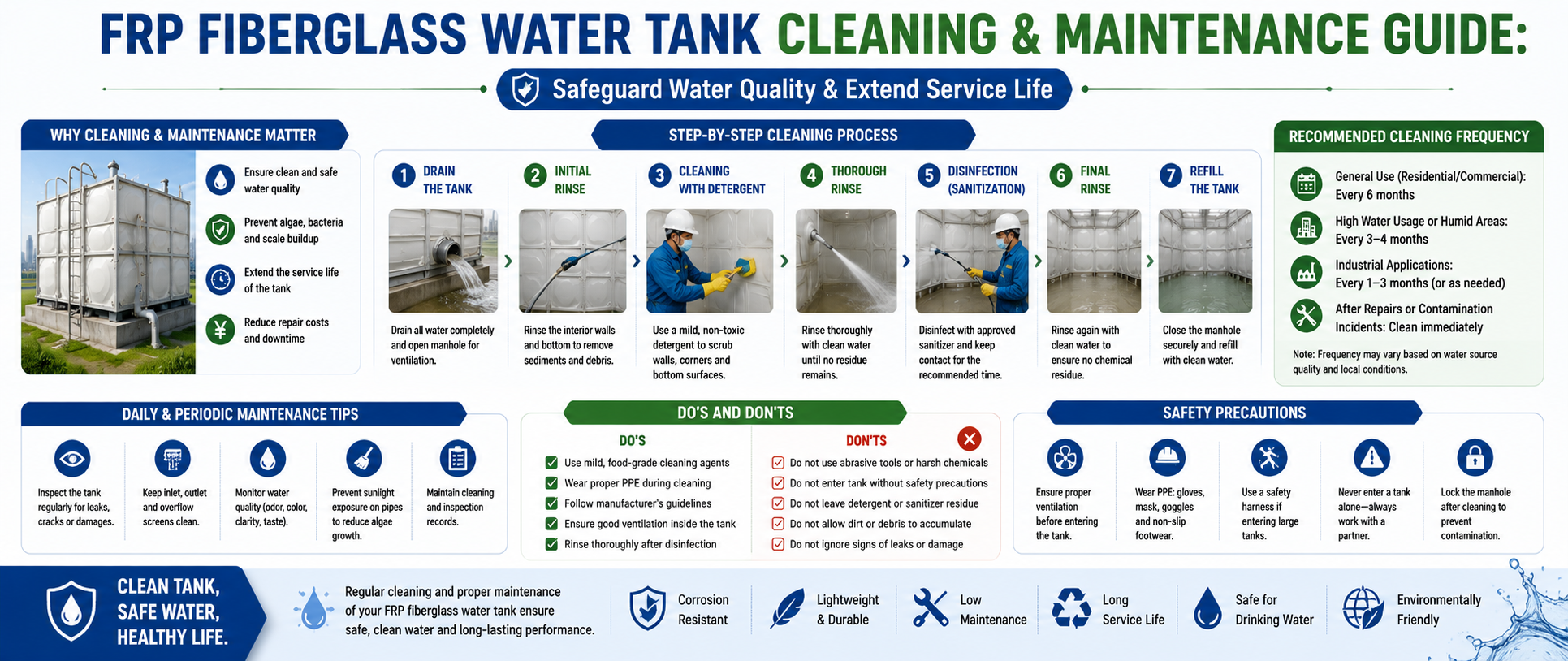
FRP (fiberglass-reinforced plastic) water tanks have become the preferred storage solution for residential, commercial, industrial, and municipal water supply systems, thanks to their food-grade safety, corrosion resistance, and long service life. Unlike traditional steel and concrete water tanks, high-quality fiberglass water tanks feature smooth inner walls, anti-aging performance, and no secondary pollution. However, even the most durable FRP water storage tank requires standardized regular c
1. Food-Grade Material Standards for Qualified FRP Water Tanks
Water quality safety fundamentally depends on the tank’s material quality. Only food-grade FRP water tanks are suitable for drinking water storage, and they must comply with international water storage safety standards.
Qualified food-grade fiberglass water tanks adopt high-purity food-grade resin and alkali-free glass fiber materials, with the following core advantages: no toxic or harmful substances precipitation, no reaction with water quality, anti-algae and anti-bacterial properties, and resistance to weak acid and weak alkali corrosion. Inferior industrial-grade FRP materials will cause water turbidity, odor, and microbial exceeding the standard, seriously endangering water supply safety. Therefore, material compliance is the primary premise for the daily use and maintenance of water storage tanks.
2. Scientific Cleaning Frequency & Step-by-Step Cleaning Methods
Regular cleaning is the key to preventing sediment accumulation, algae reproduction, and water quality deterioration in fiberglass water storage tanks. The cleaning cycle varies according to the usage scenario and water source quality.
Recommended Cleaning Frequency
Drinking water FRP tanks (residential & commercial): Deep cleaning and disinfection every 6 months
Industrial circulating water tanks: Comprehensive cleaning once a year
Special environments (high temperature, dust-prone areas): Increase cleaning frequency appropriately to avoid sediment accumulation
Standard Cleaning Steps
First, cut off the water inlet and power supply, drain the remaining water in the tank completely, and ventilate the tank interior fully. Then use a soft brush or professional water tank cleaning tool to scrub the inner wall gently to remove sediment, scale, and residual algae. It is forbidden to use hard tools such as steel brushes to avoid scratching the FRP inner wall and damaging the anti-corrosion and anti-pollution layer.
After scrubbing, rinse the tank repeatedly with clean water. For sterilization and disinfection, use food-grade disinfectants in a reasonable proportion to soak and disinfect the tank interior, then rinse thoroughly again to ensure no disinfectant residue. Finally, drain all wastewater and restore the water supply system.
3. FRP Water Tank Sealing Maintenance Skills
The sealing performance of the assembled FRP panel water tank directly affects its waterproof effect and service life. Most tank leakage problems are caused by aging, loosening, or improper maintenance of sealing accessories.
Daily maintenance should focus on checking the rubber sealing gaskets between tank panels, the joints of water inlet and outlet pipes, and the sealing parts of the manhole cover. Regularly remove dust and sediment from the sealing gaps to prevent hard impurities from squeezing and damaging the gaskets. Check the elasticity and tightness of the gaskets quarterly; replace aging, hardened, or deformed rubber gaskets in time to avoid gap leakage.
In addition, keep the manhole cover tightly closed daily to prevent external dust, debris, mosquitoes, and bacteria from entering the tank and causing secondary water pollution.
4. Key Water Quality Detection Notes for FRP Tanks
Cleaning and maintenance must be matched with regular water quality testing to ensure long-term water safety. After each tank cleaning and disinfection, water quality sampling and testing must be carried out before putting the tank into use again.
Focus on detecting key indicators such as water turbidity, odor, total bacterial count, residual chlorine, and heavy metal content. For water tanks used in hospitals, schools, and food processing factories, enhance regular professional water quality testing to meet industry water supply standards. Once abnormal water quality indicators are found, stop water use immediately, re-clean and disinfect the tank, and troubleshoot potential pollution sources.
5. Common FRP Water Tank Leakage Problems & Solutions
Leakage is the most common fault in the daily operation of fiberglass water tanks. Targeted solutions can quickly solve problems and avoid greater losses:
Panel joint leakage: Mostly caused by loose bolts or aging gaskets. Retighten the fixing bolts evenly and replace the damaged sealing gaskets to restore sealing performance.
Pipe interface leakage: Caused by loose pipe fittings or damaged sealing rings. Readjust the pipe installation tightness and replace the aging sealing accessories.
Local tank wall leakage: Minor cracks caused by external impact or aging. Use professional FRP repair materials for bonding and anti-corrosion reinforcement to repair leakage points.
It is recommended to conduct a full-scale leakage inspection of the water tank every six months to eliminate hidden dangers in advance.
Conclusion
A high-quality food-grade FRP water tank can serve for more than 20 years with scientific daily maintenance. Standardized cleaning cycles, professional sealing protection, regular water quality detection, and timely troubleshooting of leakage faults are essential measures to ensure water supply safety and extend the service life of fiberglass water tanks.
Adhering to fine maintenance management can not only avoid water quality pollution risks but also reduce equipment replacement and maintenance costs, bringing long-term stable value for water storage systems in various industries.
Tags: #FRPWaterTank #FiberglassWaterTank #WaterTankMaintenance #FoodGradeWaterTank #WaterQualitySafety #IndustrialWaterStorage