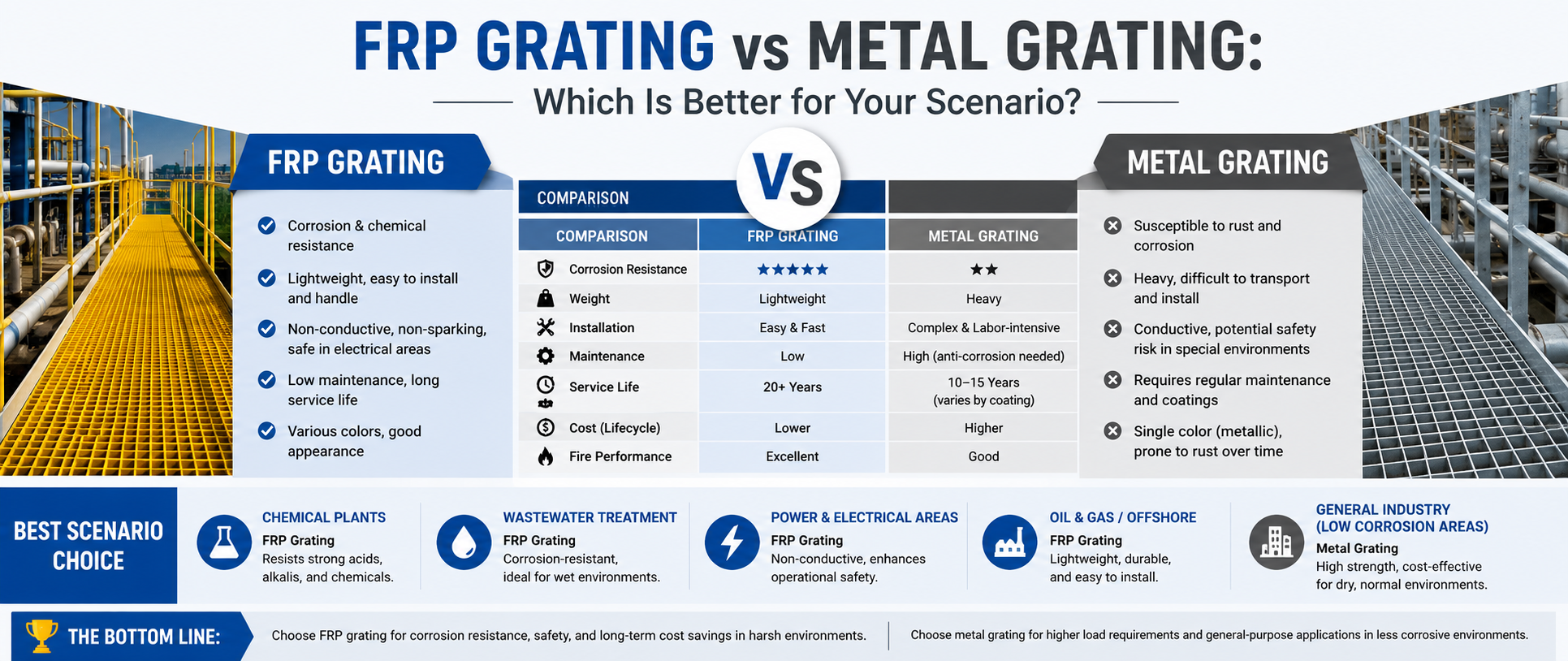
Cost Comparison: Initial Investment vs Long-term Investment, Which Is More Cost-effective?
III. Cost Comparison: Initial Investment vs Long-term Investment, Which Is More Cost-effective?
When purchasing gratings, we should not only look at the initial purchase cost, but also take into account the long-term maintenance cost and replacement cost to calculate the cost performance comprehensively. The cost difference between the two is very obvious:
1. Initial Purchase Cost
FRP Grating: The initial purchase cost is slightly higher than that of carbon steel gratings, about 1.2-1.5 times that of carbon steel gratings, but lower than that of stainless steel gratings (the cost of stainless steel gratings is 2-3 times that of FRP gratings); the cost of molded FRP gratings and pultruded FRP gratings is slightly different, and pultruded gratings are slightly lower in cost, suitable for large-area laying scenarios.
Metal Grating: Carbon steel gratings have the lowest initial purchase cost and are the choice with the lowest cost performance; stainless steel gratings have the highest initial purchase cost; the cost of aluminum gratings is between carbon steel and FRP, but their strength is insufficient, and additional thickness is required to improve load-bearing capacity, which will increase the cost instead.
2. Long-term Use Cost (Transportation + Installation + Maintenance + Replacement)
FRP Grating: It has obvious lightweight advantages, no large equipment is needed for transportation, and 2-3 people can complete the installation. The transportation and installation costs are more than 60% lower than those of metal gratings; no derusting, painting or maintenance is required in the later period, only regular cleaning is needed, and the maintenance cost is almost negligible. The service life is as long as 20-30 years, and no frequent replacement is needed, so the long-term total cost is the lowest.
Metal Grating: It is heavy in weight, requiring large trucks for transportation and heavy equipment such as cranes for installation, with high transportation and installation costs; carbon steel gratings need derusting and anti-corrosion painting once or twice a year, and the annual maintenance cost is about 10%-15% of the purchase cost; although the maintenance cost of stainless steel gratings is lower than that of carbon steel, the initial investment is high, and corrosion may still occur after long-term use, requiring replacement of components, so the long-term total cost is much higher than that of FRP gratings.
Core Conclusion: For long-term use (more than 5 years), FRP gratings are more cost-effective; for short-term use (less than 3 years) and no corrosion, light load scenarios, carbon steel metal gratings can be selected to reduce initial investment.
IV. Scenario Adaptation Suggestions: Accurate Model Selection Without Pitfalls for Different Scenarios
Combined with the performance and cost differences between the two, we give clear model selection suggestions for different core scenarios to help you quickly match the suitable grating type and implant scenario-based SEO keywords:
1. Industrial Scenarios (Chemical Plants, Sewage Treatment Plants, Power Plants, Metallurgical Plants)
Core Needs: Corrosion resistance, strong load-bearing capacity, easy maintenance, mostly acid-base, sewage, and humid environments. FRP gratings are preferred.
Specific Adaptation: For chemical plant operation platforms, sewage treatment plant walkways, power plant maintenance platforms, and laying in corrosive areas of metallurgical plants, it is recommended to choose molded FRP gratings. The thickness is 30-50mm according to load-bearing requirements, and the aperture is 38×38mm, which takes into account anti-slip and load-bearing. No later anti-corrosion maintenance is needed, reducing the long-term investment of enterprises.
2. Municipal & Outdoor Scenarios (Park Walkways, Municipal Guardrails, Outdoor Platforms, Coastal Areas)
Core Needs: Aging resistance, corrosion resistance, lightweight, easy installation, mostly outdoor wind and rain, humid, and salt spray environments. FRP gratings are preferred.
Specific Adaptation: For park pedestrian walkways, municipal greening guardrails, outdoor landscape platforms, and coastal plank roads, pultruded FRP gratings are selected, which are light in weight, easy to install, UV resistant, aging resistant, not easy to deform or fade after long-term use, and no frequent maintenance is needed, reducing municipal maintenance costs.
3. Indoor & Ultra-heavy Load Scenarios (Workshop Heavy Equipment Platforms, Warehouse Shelves, Indoor Walkways)
Core Needs: Ultra-high load-bearing capacity, no corrosion hazards. Metal gratings are preferred; for conventional load-bearing and indoor dry scenarios, flexible selection can be made.
Specific Adaptation: For heavy equipment maintenance platforms and warehouse heavy shelf laying, carbon steel metal gratings are selected to ensure that the load-bearing capacity meets the standards; for indoor pedestrian walkways and ordinary workshop platforms, FRP gratings can be selected, which have prominent lightweight advantages, easy installation, good insulation, and avoid electric leakage hazards.
4. Special Scenarios (Electrical Platforms, Medical Scenarios, Food Processing Workshops)
Core Needs: Insulation, non-toxicity, easy cleaning, corrosion resistance. FRP gratings are preferred.
Specific Adaptation: For electrical equipment operation platforms, FRP gratings have good insulation, which can effectively prevent electric leakage; for medical scenarios and food processing workshops, FRP gratings made of food-grade resin are selected, which are non-toxic, sterile, easy to clean, meet industry standards, and corrosion resistant to avoid pollution.
V. Installation and Maintenance Comparison: Which Is More Worry-free and Labor-saving?
The installation difficulty and maintenance cost of gratings directly affect the construction efficiency and later use experience. The differences between the two are very obvious, and the specific comparison is as follows:
1. Installation Comparison
FRP Grating: Light in weight (only 15-25kg per square meter), no heavy equipment such as cranes is needed, 2-3 people can carry and lay it. Special connectors are used for splicing during installation, no welding is needed, and the construction efficiency is high. 100 square meters of gratings can be installed in 1-2 days, especially suitable for high-altitude and remote scenario installation.
Metal Grating: Heavy in weight (50-80kg per square meter for carbon steel gratings), large trucks are needed for transportation, and heavy equipment such as cranes are needed for installation. Professional personnel are required for welding and fixing, with high construction difficulty and low efficiency. 100 square meters of gratings need 3-5 days to install, and the construction cost is high.
2. Maintenance Comparison
FRP Grating: Simple maintenance, no derusting, painting or maintenance is needed, only regular flushing with clean water to remove surface dust and debris, the later maintenance cost is almost zero, the service life is as long as 20-30 years, and no frequent replacement is needed.
Metal Grating: High maintenance cost, carbon steel gratings need derusting and anti-corrosion painting once or twice a year, stainless steel gratings need cleaning and maintenance every 2-3 years, aluminum gratings need regular inspection of oxidation and replacement of damaged components; and metal gratings have a short service life, which need to be replaced as a whole in 5-10 years, and the later investment increases significantly.
VI. Conclusion: FRP Grating vs Metal Grating, 3 Key Points for Model Selection
Based on the above comparison, there is no absolute "good or bad" between FRP gratings and metal gratings, only "whether they are suitable". The core model selection logic can be summarized into 3 points to help you make quick decisions:
Look at the environment: For scenarios with corrosion, humidity, outdoor, coastal areas, directly choose FRP gratings; for indoor dry and non-corrosive scenarios, consider metal gratings.
Look at the load-bearing capacity: For conventional heavy load (300-500kg/㎡), FRP gratings can fully meet the needs; for ultra-heavy load (more than 500kg/㎡), choose carbon steel metal gratings.
Look at the cost: For long-term use (more than 5 years), FRP gratings are more cost-effective; for short-term use and limited initial budget, carbon steel metal gratings can be selected (for non-corrosive scenarios).
Nowadays, with the industrial upgrading and the popularization of environmental protection concepts, FRP gratings have gradually replaced metal gratings and become the preferred choice for most scenarios due to their advantages of corrosion resistance, lightweight, low maintenance and long service life. As a professional FRP product supplier, we can customize FRP gratings of different specifications according to your specific scenarios and load-bearing requirements, and provide one-stop installation guidance and after-sales support.
In the follow-up, we will update the model selection parameters, installation tutorials and maintenance skills of FRP gratings. Follow our blog to unlock more practical knowledge of FRP gratings; at the same time, you can check the FRP grating product introduction released on our LinkedIn every day to learn about specific specifications, cases and quotations, helping you select models accurately and reduce costs~