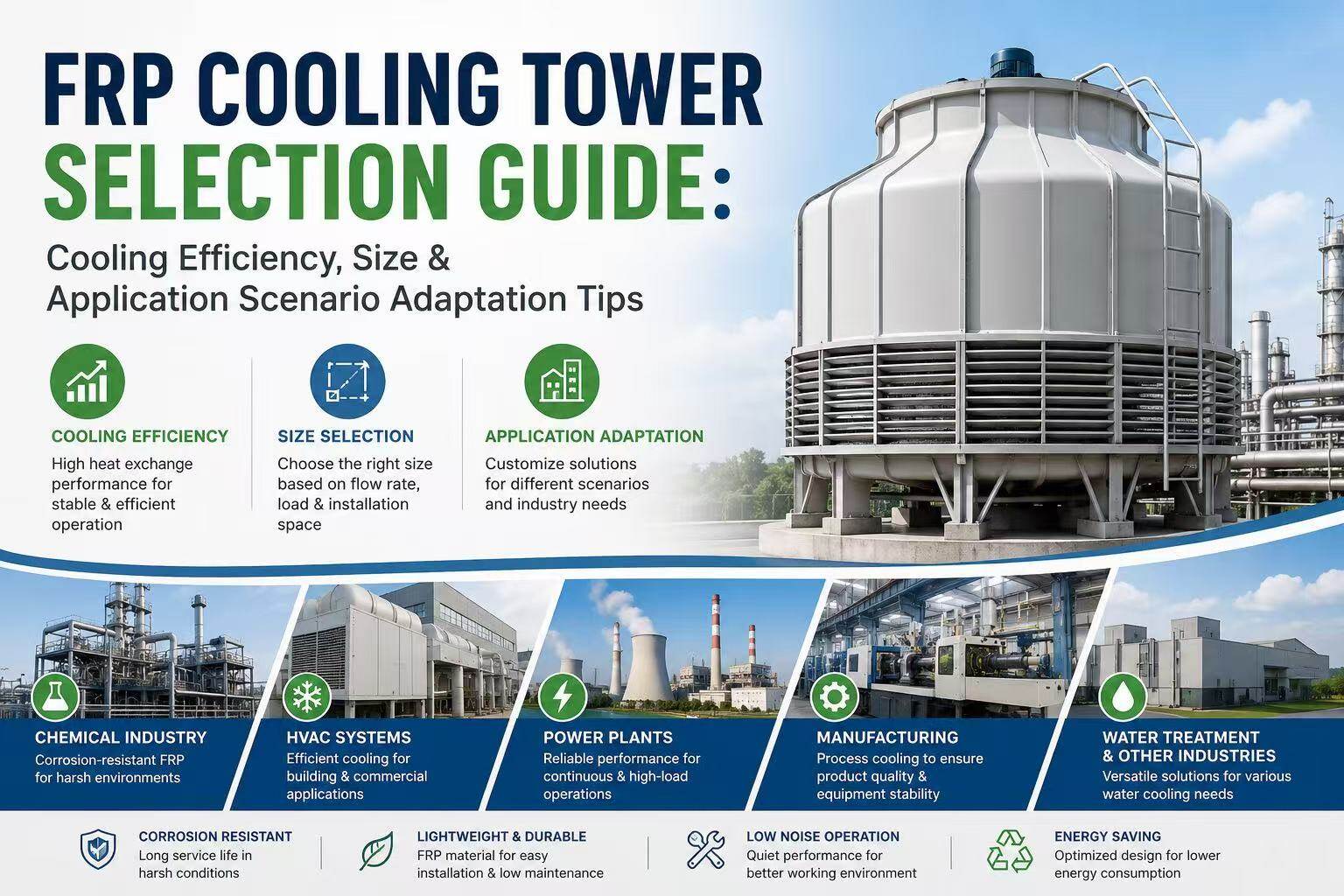
FRP cooling towers are essential industrial heat dissipation equipment, favored across power, chemical and manufacturing sectors for corrosion resistance, light weight and long service life. Improper selection often leads to inadequate cooling, space issues and high energy costs. This guide elaborates on their working principles, key efficiency factors, selection criteria, installation rules and energy-saving tips for accurate model matching.
1. Working Principle of FRP Cooling Towers
The core working logic of an FRP cooling tower is heat and mass transfer between water and air, which realizes the cooling of circulating industrial water through physical evaporation and heat exchange. The high-temperature process water is sprayed evenly onto the tower packing through the water distribution system, forming a thin water film to maximize the contact area with air. At the same time, the fan drives ambient air to flow in reverse or cross flow with the water flow inside the tower.
During the contact process, part of the water evaporates and takes away a large amount of latent heat, while the residual heat is transferred to the air through convection heat transfer. The hot and humid air is discharged out of the tower, and the cooled circulating water falls to the water tank at the bottom of the tower, realizing cyclic heat dissipation. Compared with traditional metal cooling towers, FRP towers feature better thermal stability and anti-corrosion performance, ensuring efficient and stable heat exchange in harsh industrial environments.
2. Key Factors Affecting FRP Cooling Tower Efficiency
Cooling efficiency is the core index to measure the performance of FRP cooling towers. Multiple internal and external factors jointly determine the final heat dissipation effect, which are the key basis for model selection:
2.1 Structural Design Factors
Tower packing quality and layout are the core of heat exchange. High-quality PVC/FRP packing has a large specific surface area and good hydrophilicity, which can form a uniform water film and avoid water flow short circuit, greatly improving heat exchange efficiency. In addition, fan power, air volume design and water distribution uniformity also directly affect air-water contact sufficiency. Unreasonable water distribution will lead to local dry packing and reduce overall cooling capacity.
2.2 Environmental Operating Conditions
Ambient wet bulb temperature is the most critical environmental factor. The lower the local wet bulb temperature, the larger the temperature difference between air and water, and the higher the cooling efficiency. Meanwhile, air humidity, wind speed and altitude will also interfere with heat dissipation effect. In high-humidity coastal areas, the evaporation rate of water decreases, and the actual cooling capacity of the tower will be slightly reduced, so margin selection is required.
2.3 Operating Parameter Settings
Circulating water flow rate and inlet water temperature match the tower’s rated parameters. Excessive water flow will cause water overflow and incomplete heat exchange, while too small flow will lead to low equipment utilization. The higher the inlet water temperature, the more obvious the heat exchange effect, but exceeding the tower’s rated temperature range will cause equipment overload and accelerate aging.
3. Professional Selection Parameters for Different Industries
Different industrial scenarios have differentiated requirements for cooling capacity, tower size, corrosion resistance and operating stability. Targeted parameter selection is the key to scenario adaptation:
3.1 Power Industry Selection Parameters
Power plants have large circulating water volume and continuous high-load operation requirements, which put forward high standards for the stability and cooling capacity of FRP cooling towers. It is recommended to select large-scale counter-flow FRP cooling towers with rated cooling capacity ranging from 500RT to 5000RT. The inlet water temperature is generally designed at 42℃-45℃, and the outlet water temperature is required to be controlled at 32℃-35℃. The equipment needs to support 24-hour uninterrupted operation, with strict requirements for fan stability and anti-vibration performance. In addition, power plant equipment is outdoors for a long time, so the FRP shell needs to have UV resistance and weather resistance to avoid aging and cracking.
3.2 Chemical Industry Selection Parameters
Chemical production involves corrosive media such as acid, alkali and salt, so corrosion resistance is the primary selection index for chemical FRP cooling towers. It is necessary to select high-grade anti-corrosion FRP materials and anti-corrosion packing and water distribution pipes. The conventional cooling capacity ranges from 100RT to 2000RT, adapting to the circulating water temperature of chemical reaction equipment. For fine chemical and pharmaceutical chemical scenarios with strict temperature control, the temperature control accuracy of the tower needs to be within ±1℃. For chemical plants with limited installation space, compact cross-flow FRP cooling towers are preferred to save floor space.
4. Standard Installation Precautions for FRP Cooling Towers
Reasonable installation is the premise to ensure the full play of cooling tower performance and extend service life. The key installation specifications are as follows:
First, site selection and foundation construction. The installation site should be open and well-ventilated, avoiding enclosed spaces and areas with long-term shelter to prevent hot air reflux from affecting cooling efficiency. The foundation must be flat and firm, with a reserved drainage slope to ensure smooth sewage discharge and avoid water accumulation at the bottom of the tower causing corrosion.
Second, equipment assembly standards. Ensure the verticality of the tower body during installation, and the connection of each component (fan, water distribution pipe, packing, water tank) is tight and sealed to prevent water leakage and air leakage. The fan blade gap should be adjusted reasonably to avoid friction with the tower body and reduce operating noise and loss.
Third, pipeline matching requirements. The caliber of inlet and outlet water pipelines should match the rated flow rate of the tower to avoid pipeline blockage and flow instability. It is necessary to install filters at the water inlet to prevent impurities from entering the tower and blocking the packing, which affects heat exchange efficiency.
5. Practical Energy-Saving Skills for FRP Cooling Towers
FRP cooling towers run for a long time in industrial production, and optimized operation can effectively reduce enterprise energy consumption costs without affecting cooling effect:
First, intelligent frequency conversion adjustment. Install frequency converters for cooling tower fans and water pumps, adjust operating speed in real time according to ambient temperature and production heat dissipation demand. Reduce fan speed in low-temperature and low-load seasons to avoid ineffective power consumption, which can save 20%-30% of electric energy annually.
Second, regular maintenance and cleaning. Clean packing, water tank and filter impurities regularly to prevent scaling and blockage. Scaling on the packing surface will reduce heat exchange efficiency and increase equipment operating load. Regular cleaning can maintain stable cooling performance and reduce energy consumption.
Third, optimize water circulation management. Adopt closed circulating water treatment technology, add scale inhibitors and corrosion inhibitors appropriately, reduce water evaporation loss and equipment corrosion. Reasonably control the water replenishment volume to realize water and energy dual saving.
Fourth, scientific operation management. Avoid long-term overload operation of the equipment, formulate targeted operation strategies according to seasonal temperature changes, and turn off idle cooling tower units in time to avoid no-load energy consumption.
Conclusion
The selection of FRP cooling towers needs to comprehensively consider working principle characteristics, cooling efficiency influencing factors, industry application scenarios, installation specifications and energy-saving operation requirements. For power, chemical and other industrial fields, targeted selection of cooling capacity, size and structural configuration can not only meet efficient heat dissipation demand, but also reduce long-term operating and maintenance costs. Mastering the above selection and operation skills can help enterprises avoid selection mistakes, maximize the performance advantages of FRP cooling towers, and realize stable, efficient and energy-saving industrial operation.