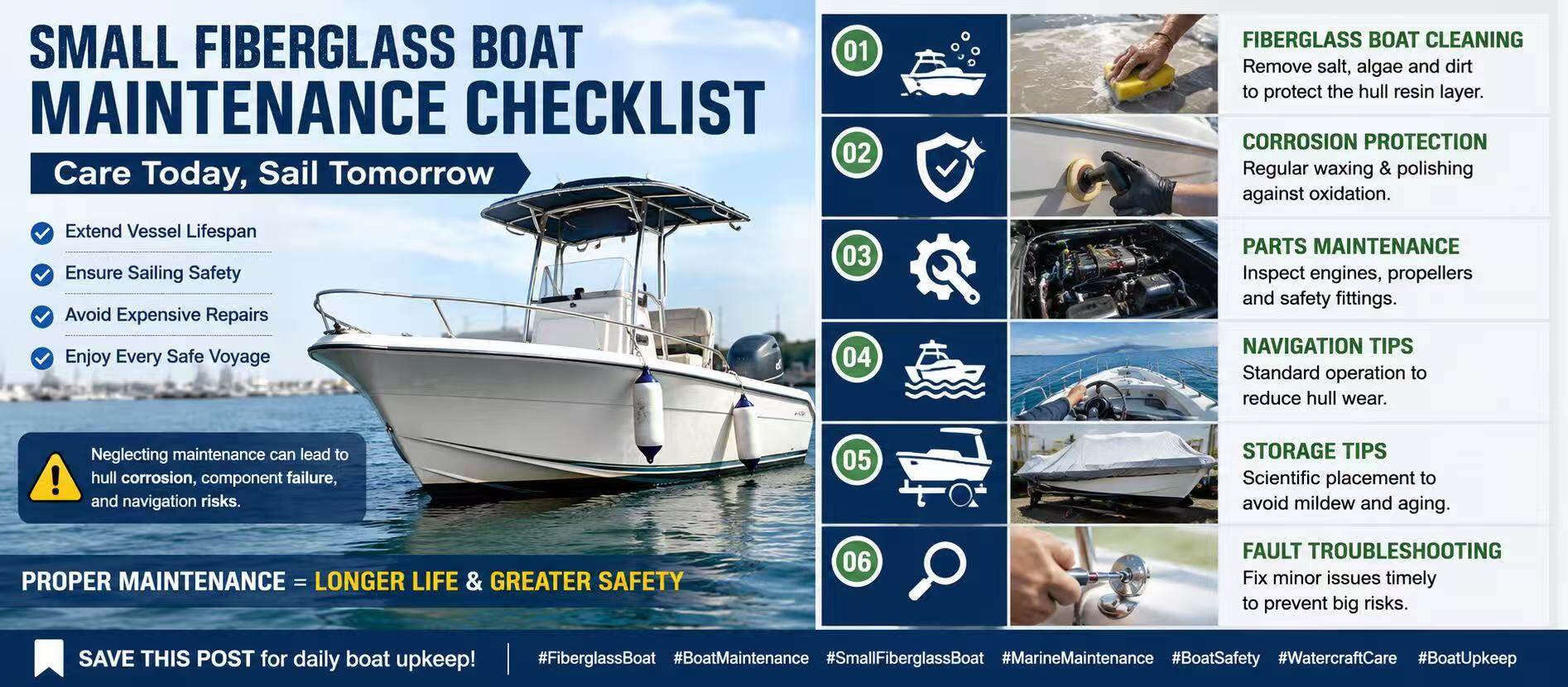
Extend Service Life and Improve Navigation Safety
1. Scientific Hull Cleaning Methods: The Foundation of Fiberglass Boat Maintenance
The fiberglass hull is composed of resin and glass fiber composite materials, which has good waterproof and anti-aging properties, but it is extremely vulnerable to the adhesion of seawater salt stains, lake algae, sediment, oil stains, and marine microorganisms. Long-term dirt accumulation will not only destroy the smooth surface of the hull, increase navigation resistance and fuel consumption, but also corrode the resin layer, cause hull fading, peeling, and even hidden structural damage. Therefore, regular hull cleaning is the most basic and core part of fiberglass boat daily maintenance.
First of all, implement timely surface cleaning after each use. For boats sailing in seawater, salt crystallization will form on the hull surface and gaps after water evaporation. It is necessary to rinse the entire hull thoroughly with clean fresh water within 24 hours after each voyage, including the hull exterior, bottom, deck, handrails, and hull gaps, to completely wash away residual salt stains and seawater. For freshwater vessels, rinse off surface sediment, algae and floating dirt with fresh water after each use to avoid long-term adhesion and mold growth.
Secondly, conduct deep cleaning regularly. It is recommended to perform a comprehensive deep cleaning every 1-2 months during the frequent use period. For stubborn dirt such as aged algae, oil stains, and mold spots on the hull surface, use professional fiberglass boat cleaning agents instead of strong acid and alkali detergents. Strong corrosive detergents will damage the protective resin layer of the fiberglass, cause the hull to lose luster, crack and age. During cleaning, use soft sponges, microfiber cloths or soft bristle brushes to wipe the hull gently. Avoid hard steel brushes and sharp tools to prevent scratching the fiberglass surface. For the hull bottom that is immersed in water for a long time and prone to thick algae attachment, you can soak and clean it with a special algae remover, and rinse it clean after standing for an appropriate time.
In addition, pay attention to dry cleaning and detail cleaning. After cleaning, let the hull dry naturally in a ventilated and cool environment, avoid long-term exposure to strong sunlight when wet, to prevent uneven fading of the hull. At the same time, focus on cleaning dead corners such as hull seams, drainage holes, and accessory connection gaps to prevent dirt accumulation and mildew corrosion in hidden parts.
2. Professional Anti-Corrosion Treatment: Avoid Hull Aging and Damage
Corrosion and aging are the main factors that shorten the service life ofsmall fiberglass boats. Although fiberglass materials have natural anti-corrosion advantages, the resin layer will gradually age, oxidize and peel under the long-term erosion of water, ultraviolet rays, temperature changes and marine corrosive substances. Especially for small fiberglass boats used in coastal seawater environments, salt erosion and ultraviolet radiation will accelerate hull aging. Timely and standardized fiberglass boat corrosion protection is essential to maintain hull integrity.
The first key step of anti-corrosion maintenance is regular hull waxing and polishing. After each deep cleaning and hull drying, it is recommended to polish the hull surface every 3 months during the use season. Polishing can remove the oxidized old resin layer, fine scratches and faded layers on the hull surface, restore the smoothness and gloss of the fiberglass. After polishing evenly, apply professional marine-grade fiberglass boat wax. The wax layer can form a dense protective film on the hull surface, effectively isolating ultraviolet rays, water stains, salt stains and air oxidation, and greatly enhance the hull's anti-aging and anti-corrosion ability. For boats stored outdoors for a long time, the wax protection cycle can be shortened to 2 months.
The second step is targeted anti-corrosion treatment for damaged parts. During daily use, the hull may have fine scratches, peeling resin, small cracks and other damage. These tiny damages are the main breakthrough points for corrosion. Once found, they need to be repaired and anti-corrosive treated in time. For fine surface scratches, polish and wax them immediately; for partial resin peeling and small crack defects, clean the damaged area, dry it thoroughly, and use professional fiberglass repair glue and resin for filling and repairing. After curing, polish and wax again to ensure the protective layer is complete and closed.
In addition, do a good job in anti-corrosion of metal matching parts. The metal accessories such as bolts, brackets, propeller shafts and connectors matched with fiberglass boats are prone to rust and corrosion. It is necessary to regularly apply anti-rust oil and marine anti-corrosion coating on metal parts, replace severely rusted accessories in time, and avoid metal corrosion expansion affecting the connection stability of the fiberglass hull.
3. Systematic Parts Maintenance: Ensure Stable Operation of the Whole Vessel
The safe navigation of small fiberglass boats depends on the normal operation of all supporting parts. Hull damage is mostly gradual aging, while part failure is the main cause of sudden navigation faults. Daily fiberglass boat parts maintenance covers power system, navigation accessories, control system and safety equipment, and systematic inspection and maintenance can eliminate most potential faults in advance.
In terms of power system maintenance, focus on the outboard engine or inboard engine of the fiberglass boat. Check the engine oil quantity and quality regularly every month, replace the engine oil and filter element according to the service cycle, and ensure the lubrication effect of the power system. Inspect the fuel pipeline and water inlet pipeline for aging, cracking, leakage and blockage, clean the pipeline filter regularly to avoid water and oil supply blockage. After each use of the engine, drain the residual water in the pipeline and engine body to prevent water freezing and pipeline cracking in low temperature environment, and avoid residual water breeding bacteria and corroding the engine interior.
In terms of control and navigation parts, regularly check the flexibility and tightness of the steering system, throttle control lever and connecting cables. Ensure that the steering is sensitive and free of jamming and delay, and tighten loose bolts and connecting parts in time. Inspect the propeller for deformation, crack, abrasion and winding of aquatic weeds and fishing lines. Deformed propellers will affect navigation stability and increase power consumption, and severely damaged propellers need to be replaced in time. At the same time, check the hull drainage system, ensure that the drainage holes are unobstructed, and clean the accumulated water in the cabin in time to avoid long-term water accumulation soaking the hull and accessories.
In terms of safety accessories maintenance, regularly inspect life jackets, life buoys, fire extinguishers, anchor ropes, mooring ropes and other equipment. Check whether the life-saving equipment is intact and valid, whether the ropes are worn, aged or broken, and replace aging and damaged safety accessories regularly. For electronic navigation equipment such as depth sounders and GPS, check the power supply and signal stability regularly, clean the equipment surface and sensors, and avoid water ingress and dust accumulation affecting the use effect.
4. Standard Water Navigation Precautions: Reduce Hull and Component Loss
Many boat owners ignore the impact of navigation operation habits on the service life of fiberglass boats. Irregular driving and improper operation will cause unnecessary damage to the hull and parts, accelerate aging and wear, and even trigger safety accidents. Mastering scientific fiberglass boat navigation tips can not only ensure navigation safety, but also effectively reduce vessel loss and reduce maintenance costs.
First, abide by standardized driving operation specifications. Avoid sharp acceleration, sharp turning and sudden braking during navigation. Fierce operation will cause instantaneous impact on the hull, easily leading to loose internal structural parts, and the strong water impact will scratch and damage the hull surface. When sailing in shallow water areas, slow down in advance to avoid the hull bottom rubbing against underwater reefs, sandbars and gravel, which will cause scratches and cracks on the fiberglass bottom. It is strictly forbidden to sail in extreme weather such as strong winds, heavy rains and high waves. Rough water waves will cause severe hull shaking and impact, which will not only damage the hull structure, but also bring serious safety risks.
Second, control the load reasonably. Each small fiberglass boat has a rated load capacity and passenger capacity. Overloading will cause the hull to sink too deep, increase water resistance, aggravate the load of the power system, and easily lead to hull deformation and structural fatigue for a long time. At the same time, avoid placing sharp, heavy and corrosive items in the cabin. Sharp items are easy to scratch the hull inner wall, heavy items will cause local pressure deformation of the hull, and corrosive items will leak and corrode the cabin structure.
In addition, do a good job in real-time inspection during navigation. During the voyage, always pay attention to the operating state of the engine, the sensitivity of the steering system, and whether there is abnormal noise, vibration and water leakage in the hull. Once abnormal conditions are found, stop the boat for inspection in time to avoid small faults expanding into large damage. When docking and anchoring, operate gently, avoid violent collision between the hull and the shore, dock and other ships, and use buffer anti-collision pads to protect the hull edge.
5. Scientific Storage Skills: Avoid Idle Aging and Damage
Most small fiberglass boats are used seasonally and will be idle for a long time in off-seasons. Unscientific storage is one of the important reasons for hull aging, mildew, cracking and part damage. Mastering professional fiberglass boat storage tips can well protect the vessel during idle periods and avoid unnecessary maintenance costs caused by long-term idle damage.
For short-term daily storage (within 7 days), after cleaning and drying the hull, park the boat in a flat, ventilated and dry place, avoid long-term direct exposure to strong sunlight and rain soaking. Ultraviolet rays will accelerate the aging and fading of the fiberglass resin layer, and long-term rainwater accumulation will cause cabin mildew and metal parts corrosion. If stored outdoors, it is necessary to cover the hull with a special breathable boat cover to block sunlight, rain and dust.
For long-term off-season storage (more than 1 month), comprehensive protective maintenance is required first. Thoroughly clean the inside and outside of the hull, completely remove dirt, algae and water stains, and ensure the hull is fully dry. Polish and wax the whole hull again to form a thick protective layer to resist air oxidation and moisture erosion. Drain all residual water in the engine, pipeline and cabin to prevent water freezing and expansion in low temperature seasons from cracking the pipeline and hull structure. Apply anti-rust and lubricating oil to all metal movable parts, and seal and protect the power system and electronic equipment.
In terms of storage environment selection, priority should be given to indoor dry warehouse storage. If outdoor storage is unavoidable, choose a flat and dry ground with good drainage, avoid low-lying water accumulation areas, and use a boat support frame to prop up the hull to avoid long-term extrusion deformation of the hull bottom. At the same time, regularly check the storage state of the hull during the idle period, timely remove dust and accumulated water, and check whether the protective layer is damaged and the parts are aging.
6. Common Faults and Troubleshooting Solutions for Fiberglass Boats
In the daily use process of small fiberglass boats, due to aging, wear, improper operation and insufficient maintenance, some common faults will inevitably occur. Timely and accurate fiberglass boat fault troubleshooting can quickly solve problems, restore vessel performance, and avoid safety accidents caused by fault accumulation. The following are the most common faults and professional solutions for small fiberglass boats.
6.1 Hull surface fading, oxidation and fine scratches
This is the most common superficial fault, mainly caused by long-term ultraviolet radiation, water erosion and insufficient wax maintenance. The solution is to clean and dry the hull first, use professional hull polishing paste and polishing machine to polish the oxidized and faded layer, repair fine scratches, and then apply marine special wax for sealing protection. Regular waxing and maintenance can effectively prevent the recurrence of such problems.
6.2 Hull water seepage and small cracks
Long-term water impact, collision and aging of the resin layer will lead to tiny cracks and water seepage in the hull. After finding the fault, first mark the crack location, clean and dry the crack area completely, use professional fiberglass repair resin and glass fiber cloth for filling and bonding repair, polish smoothly after full curing, and carry out anti-corrosion waxing treatment to ensure the tightness of the hull.
6.3 Engine jitter, weak power and difficult start
Most of these power faults are caused by blocked fuel pipelines, aging spark plugs, insufficient engine oil and pipeline water inflow. Troubleshoot step by step: check whether the fuel pipeline is blocked and leaked, clean or replace the filter element; check the spark plug for carbon deposition and aging, replace the spark plug regularly; check the engine oil level and quality, replenish or replace engine oil in time; drain the residual water in the engine pipeline to ensure smooth power supply.
6.4 Steering inflexible and jamming
Long-term lack of lubrication, cable aging and loose connecting parts will cause steering jamming and delay. The troubleshooting method is to clean the steering connecting parts and cables, apply professional lubricating oil, tighten loose bolts and connectors, and replace severely aged and deformed steering cables to ensure flexible and sensitive steering.
6.5 Cabin mildew and peculiar smell
Long-term water accumulation and poor ventilation in the cabin will lead to mildew growth and peculiar smell. The solution is to thoroughly clean the cabin, remove mold spots with a special mildew remover, keep the cabin ventilated and dry, clean the cabin residual water in time after each use, and place desiccant properly during long-term storage to keep the cabin dry.
Conclusion
The service life and navigation safety of small fiberglass boats are entirely dependent on daily standardized maintenance and scientific use habits. Comprehensive maintenance covering hull cleaning, anti-corrosion protection, parts inspection and maintenance, standardized navigation operation, scientific storage management and timely fault troubleshooting can effectively avoid most common damage and safety hazards. Adhering to regular small fiberglass boat maintenance can not only maximize the service life of the vessel, reduce replacement and maintenance costs, but also ensure stable and safe navigation performance, bringing a safe and comfortable water activity experience for every user.