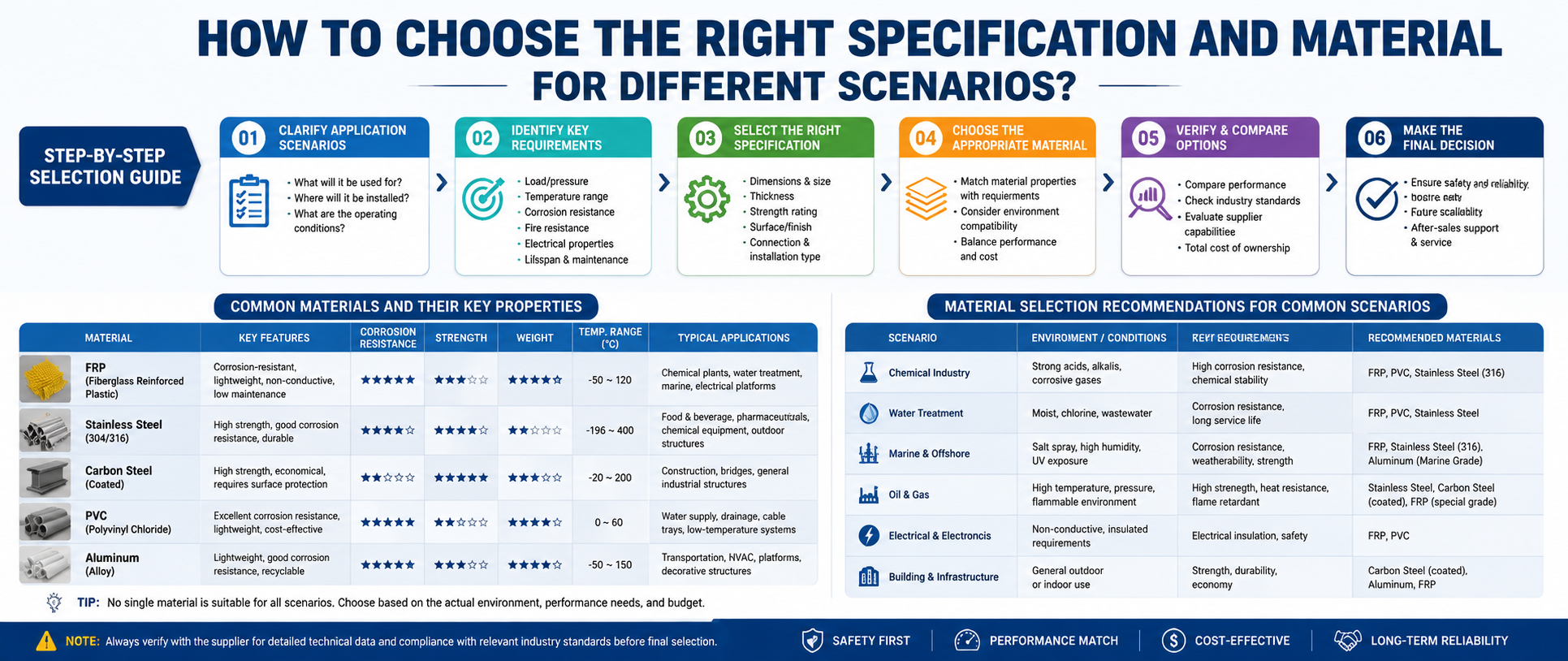
Fiberglass Reinforced Plastic (FRP) pipes have become the preferred choice in water supply and drainage, chemical industry, municipal engineering, and environmental protection projects due to their excellent corrosion resistance, lightweight, high strength, and long service life. However, choosing the right FRP pipe—including its type, specification, and material—is crucial to ensuring stable operation, reducing maintenance costs, and extending service life. This guide will break down the classi
1. Classification of FRP Pipes: Choose Based on Application Scenarios
FRP pipes are classified into different types according to their application fields and media, and each type has targeted performance characteristics. Understanding the classification is the first step in correct selection.
1.1 Water Supply and Drainage FRP Pipes
This is the most widely used type of FRP pipe, mainly used for urban water supply, domestic sewage discharge, rainwater collection, and rural water conservancy projects. It is characterized by non-toxicity, smooth inner wall (low friction resistance, no scaling), and good pressure resistance. It can effectively avoid secondary pollution of water quality, which is superior to traditional steel pipes and concrete pipes.
Key application scenarios: Urban water supply networks, residential sewage discharge, rainwater drainage systems, farmland irrigation projects.
1.2 Chemical FRP Pipes
Designed for transporting corrosive media such as acids, alkalis, salts, and organic solvents, chemical FRP pipes adopt special corrosion-resistant resins (such as vinyl ester resin, epoxy resin) as the matrix, which can resist the erosion of most chemical media. They are widely used in chemical plants, petrochemical industry, electroplating plants, and other fields.
Key application scenarios: Transportation of sulfuric acid, hydrochloric acid, sodium hydroxide and other corrosive liquids, chemical waste liquid discharge, and chemical raw material conveying pipelines.
1.3 Other Special FRP Pipes
- Oil and Gas FRP Pipes: Used for transporting crude oil, natural gas, and gas, with good pressure resistance and anti-corrosion performance, suitable for long-distance transportation and underground laying.
- Thermal Insulation FRP Pipes: Added with thermal insulation layers, used for transporting hot water, steam, and other high-temperature media, widely used in central heating and industrial thermal energy transportation.
- Sewage Treatment FRP Pipes: Optimized for sewage with high impurity content and strong corrosiveness, with good wear resistance and anti-clogging performance, suitable for sewage treatment plants and municipal sewage pipelines.
2. Key Specification Parameters of FRP Pipes: Don’t Ignore These Details
When selecting FRP pipes, the specification parameters directly determine whether they can meet the actual working conditions. The core parameters to focus on are as follows:
2.1 Diameter (DN)
The diameter of FRP pipes ranges from DN50 to DN3000 (even larger for custom products), which is selected according to the required flow rate. For example, small-diameter pipes (DN50-DN200) are suitable for residential water supply and small-scale chemical conveying; large-diameter pipes (DN500-DN3000) are used for municipal sewage, industrial wastewater discharge, and large-scale water conservancy projects.
Tip: Calculate the required diameter based on the actual flow rate and velocity to avoid insufficient flow or excessive energy consumption caused by inappropriate diameter.
2.2 Pressure Rating (PN)
The pressure rating indicates the maximum pressure that the pipe can bear, commonly ranging from PN0.6MPa to PN10MPa. It is selected according to the working pressure of the pipeline system. For example, water supply pipes usually require PN1.0-PN1.6MPa; chemical conveying pipes with high pressure need PN2.5-PN10MPa.
Note: The pressure rating should be 1.2-1.5 times the actual working pressure to ensure safety and avoid pipe burst due to pressure fluctuation.
2.3 Wall Thickness
The wall thickness of FRP pipes is related to pressure resistance, corrosion resistance, and service life. The thicker the wall, the higher the pressure resistance, but the higher the cost. It should be selected according to the medium, pressure, and service environment. For example, pipes transporting strong corrosive media or high-pressure media need thicker walls; pipes used in ordinary water supply scenarios can choose standard wall thickness.
2.4 Length and Connection Method
FRP pipes are usually supplied in lengths of 6m, 12m, etc., and can be customized according to installation needs. The common connection methods include flange connection, socket connection, and adhesive connection. Flange connection is suitable for high-pressure scenarios; socket connection is convenient for installation and disassembly, suitable for ordinary water supply and drainage; adhesive connection has good sealing performance, suitable for chemical pipelines.
3. Selection Skills for Different Media: Avoid Mistakes and Ensure Stability
The biggest advantage of FRP pipes is their corrosion resistance, but the corrosion resistance varies with the matrix resin. Therefore, the key to selection is to match the pipe material with the transported medium.
3.1 Sewage (Domestic Sewage, Industrial Sewage)
Sewage usually contains organic matter, impurities, and a small amount of corrosive substances (such as ammonia nitrogen, sulfide). It is recommended to choose FRP pipes with unsaturated polyester resin as the matrix, which has good corrosion resistance and wear resistance. For industrial sewage with high corrosiveness (such as electroplating sewage, chemical sewage), it is better to choose vinyl ester resin FRP pipes to enhance corrosion resistance.
Key points: Focus on wear resistance and anti-clogging performance, and choose the appropriate diameter and wall thickness according to the impurity content of the sewage.
3.2 Acid-Base Media (Sulfuric Acid, Hydrochloric Acid, Sodium Hydroxide, etc.)
Different acid-base media have different corrosion degrees, so the resin material must be selected accurately:
- Strong acids (sulfuric acid, hydrochloric acid, nitric acid): Choose vinyl ester resin FRP pipes, which have excellent resistance to strong acids and can avoid resin degradation and pipe damage.
- Strong alkalis (sodium hydroxide, potassium hydroxide): Epoxy resin or vinyl ester resin FRP pipes are recommended, which have good alkali resistance and can withstand long-term erosion of strong alkali media.
- Weak acids and weak alkalis (acetic acid, ammonia water): Unsaturated polyester resin FRP pipes can meet the requirements, which is cost-effective.
3.3 Water Supply (Drinking Water, Industrial Water)
For drinking water transportation, non-toxic and pollution-free FRP pipes must be selected, and the resin should meet the national drinking water standard (such as food-grade unsaturated polyester resin). The inner wall should be smooth to avoid scaling and secondary pollution. For industrial water (such as cooling water, process water), ordinary unsaturated polyester resin FRP pipes can be selected, focusing on pressure resistance and flow rate.
3.4 High-Temperature Media (Hot Water, Steam)
For media with a temperature higher than 80℃ (such as hot water, steam), it is recommended to choose heat-resistant resin FRP pipes (such as epoxy resin, phenolic resin), which can withstand high temperatures without deformation or aging. At the same time, thermal insulation layers should be added to reduce heat loss.
4. Installation Precautions for FRP Pipes: Ensure Long-Term Stable Operation
Even if the right FRP pipe is selected, incorrect installation will affect its service life and performance. The following precautions must be paid attention to during installation:
1. Avoid collision and scratch: FRP pipes have good toughness but poor impact resistance. During transportation and installation, avoid collision with hard objects to prevent scratches on the pipe surface, which may lead to corrosion and damage.
2. Correct connection: Ensure that the connection part is sealed tightly to avoid leakage. For flange connection, check the flatness of the flange surface and tighten the bolts evenly; for socket connection, apply special adhesive evenly and ensure sufficient bonding time.
3. Reasonable laying: For underground laying, avoid laying in areas with severe subsidence or sharp stones; the pipe should be supported at intervals (usually 1.5-2m) to avoid stress concentration. For above-ground laying, install anti-vibration supports to reduce the impact of pipeline vibration.
4. Avoid exposure to strong sunlight: Long-term exposure to strong sunlight will accelerate the aging of FRP pipes. For outdoor laying, take anti-ultraviolet measures (such as painting anti-ultraviolet paint) or wrap thermal insulation layers to extend service life.
5. Pressure test: After installation, conduct a pressure test (the test pressure is 1.5 times the working pressure) to check for leakage. Only after passing the test can it be put into use.
5. Maintenance Methods of FRP Pipes: Reduce Costs and Extend Service Life
FRP pipes have low maintenance costs, but regular maintenance can further extend their service life and avoid potential failures. The key maintenance methods are as follows:
1. Regular inspection: Check the pipe surface, connection parts, and supports regularly (quarterly or annually) to see if there are scratches, cracks, leaks, or loose supports. If any problem is found, handle it in time.
2. Cleaning and descaling: For water supply and drainage pipes, regularly clean the inner wall to remove scaling and impurities, which can improve flow rate and avoid blockage. For chemical pipes, clean the pipe with a neutral cleaning agent after stopping production to remove residual media and avoid corrosion.
3. Anti-aging maintenance: For outdoor pipes, reapply anti-ultraviolet paint every 3-5 years to slow down aging. For pipes in corrosive environments, check the corrosion resistance regularly and repair the damaged surface in time.
4. Avoid overloading: Do not exceed the rated pressure and temperature of the pipe during use to avoid pipe damage caused by overloading.
Conclusion: Choose the Right FRP Pipe, Ensure Efficient and Stable Operation
Selecting FRP pipes is not a "one-size-fits-all" process. It needs to be based on the application scenario, transported medium, working pressure, and temperature, and comprehensively consider the type, specification, and material of the pipe. By mastering the classification, specification parameters, selection skills, installation precautions, and maintenance methods in this guide, you can choose the most suitable FRP pipe, reduce maintenance costs, and ensure the long-term stable operation of the pipeline system.
As a professional FRP product manufacturer, we can provide customized FRP pipe solutions according to your specific needs, including material selection, specification design, and installation guidance. If you have any questions about FRP pipe selection, feel free to contact us.